
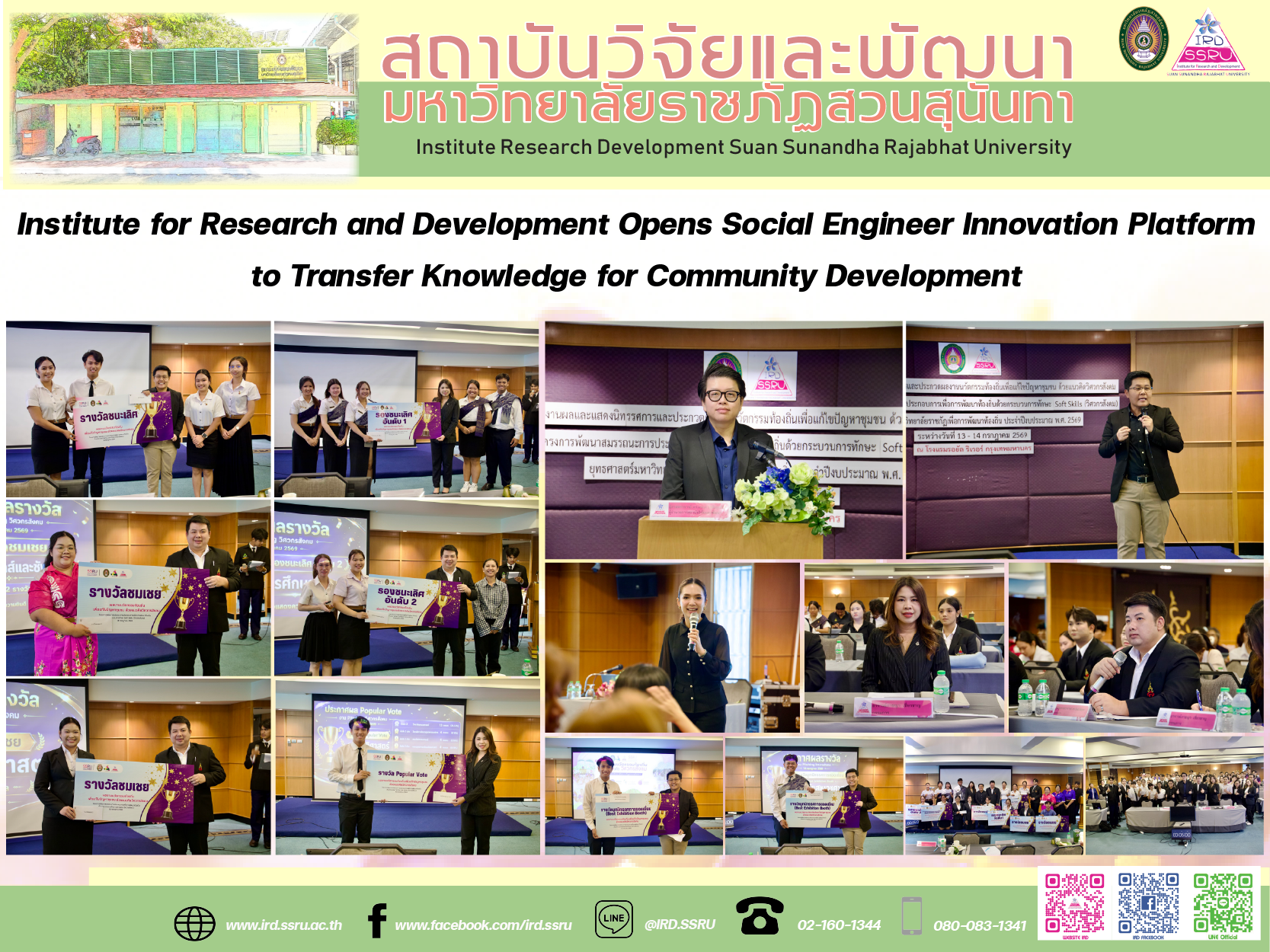
Institute for Research and Development Opens Social Engineer Innovation Platform to Transfer Knowledge for Community Development
The Institute for Research and Development, Suan Sunandha Rajabhat University, through its Intellectual Property Management and Business Incubation Division, organized a project reporting session, exhibition, and local innovation competition under the theme of solving community problems through the Social Engineer concept. The event was held from July 13 to 14, 2026, at the Royal River Hotel, Bangkok.
The activity was conducted under the project “Entrepreneurial Competency Development for Local Development through Soft Skills Processes (Social Engineer),” in accordance with the Rajabhat University Strategy for Local Development for Fiscal Year B.E. 2569. The opening ceremony was presided over by Asst. Prof. Dr. Morakot Worachairungreung, Director of the Institute for Research and Development, while Lecturer Atidtaya Buasri, Vice-Director for Intellectual Property Management and Business Incubation at the Institute for Research and Development, presented the project objectives and implementation outcomes.
The activity provided students with an opportunity to present their project outcomes and showcase innovations developed through the application of the Social Engineer concept to address community issues and support local development. It also served as a platform for knowledge exchange with experts, lecturers, and network partners, enabling students to strengthen their analytical thinking, communication, community engagement, and innovation design skills for practical application in local areas.
Prior to the competition, participating students received training on personality development and presentation skills to prepare them for communicating their project concepts and outcomes to the public. The training was delivered by Lecturer Suwita Prueksa-aporn, Vice-Director for Administration and Planning at the Office of Academic Resources and an expert in personality development.
A total of 13 innovation projects were exhibited and entered into the competition. The projects covered various areas, including education, value creation for community products, packaging design, environmental conservation, tourism promotion, community product development, and the dissemination of legal knowledge for public benefit.
The competition was judged by a panel of qualified experts, comprising Asst. Prof. Dr. Than Chaitorn, Associate Dean for Student Affairs, College of Logistics and Supply Chain; Lecturer Pachaya Chiewcharn, Associate Dean for Student Affairs, Faculty of Science and Technology; and Lecturer Atidtaya Buasri, Vice-Director for Intellectual Property Management and Business Incubation at the Institute for Research and Development. The judging panel provided recommendations and selected outstanding projects with strong potential for further development to benefit local communities.
The first prize was awarded to the Faculty of Law for the project “Legal Knowledge Handbook on Loans, Guarantees, and Mortgages for Communities.” The first runner-up award went to the College of Allied Health Sciences for the project “Development of Coconut Shell Products to Add Value to Community Goods.” The second runner-up award was presented to the Udon Thani Education Center for the project “Development of a Herbal Fermented Fish Chili Paste Formula to Reduce Fermented Fish Odor.”
In addition, honorable mention awards were presented to the College of Logistics and Supply Chain and the Faculty of Education. The Best Exhibition Booth awards went to the Faculty of Law and the College of Allied Health Sciences, while the Popular Vote award, based on visitor votes, was also presented to the Faculty of Law.
This platform reflects the university’s role in connecting learning with local development by encouraging students to apply interdisciplinary knowledge in collaboration with communities. It also provided a space for exchanging experiences among students, experts, and network partners, thereby supporting the further development of innovations that respond to local contexts.
This activity aligns with the Sustainable Development Goals (SDGs), particularly SDG 4: Quality Education, through experiential learning and student competency development, and SDG 17: Partnerships for the Goals, through collaboration among the university, experts, and network partners in supporting local development.