
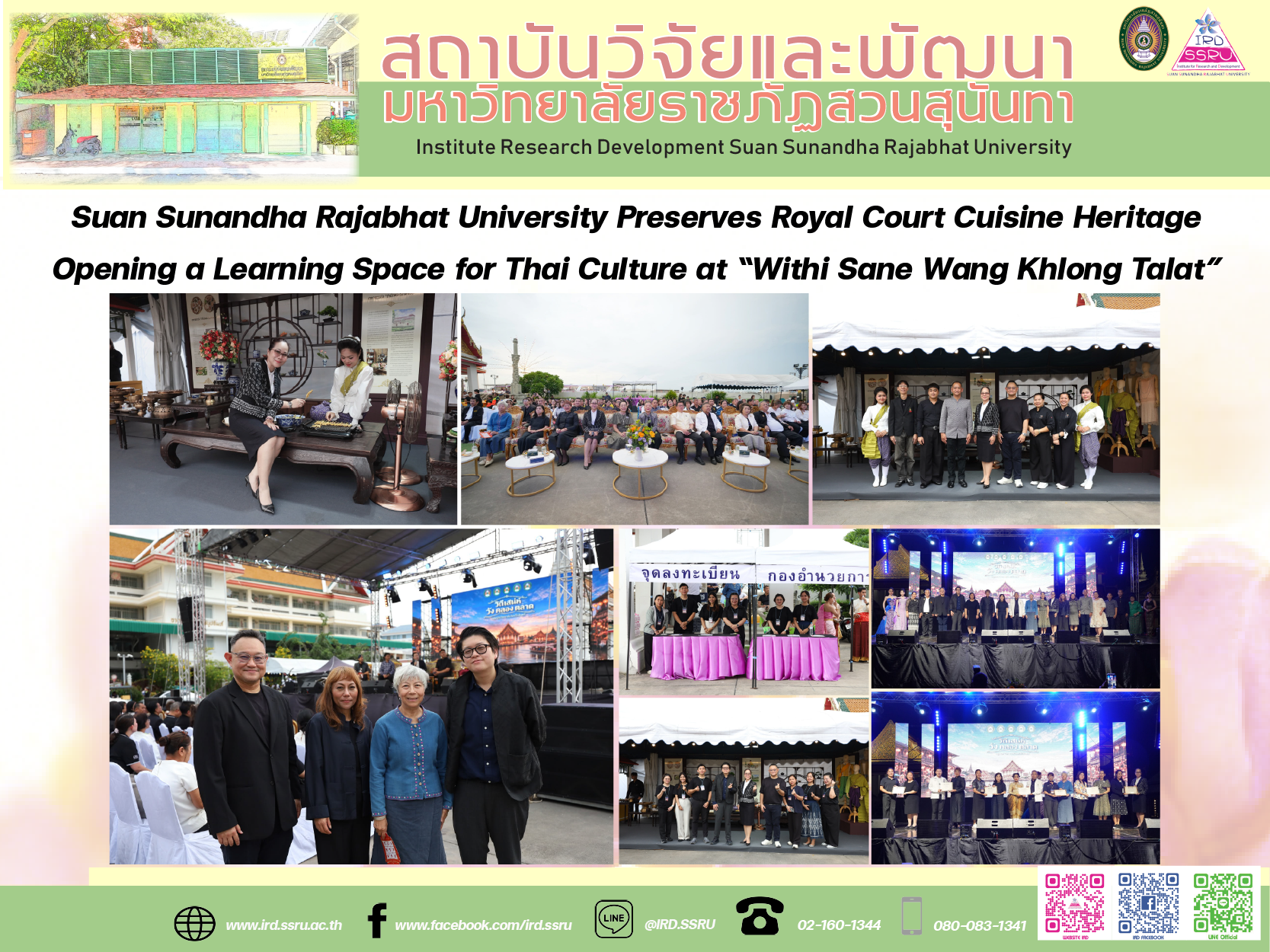
Suan Sunandha Rajabhat University Preserves Royal Court Cuisine Heritage, Opening a Learning Space for Thai Culture at “Withi Sane Wang Khlong Talat”
Suan Sunandha Rajabhat University brought its knowledge and identity in royal court cuisine to the public, opening a cultural learning space through demonstrations of traditional recipes, exhibitions, and cultural performances at “Withi Sane Wang Khlong Talat,” held from September 12 to 13, 2026, at Wat Kanlayanamit Woramahawihan, Bangkok. The activity was organized under the Rajabhat University Strategy for Local Development Project for Fiscal Year B.E. 2569.
The event was a collaboration among five Rattanakosin Rajabhat universities, namely Suan Sunandha Rajabhat University, Bansomdejchaopraya Rajabhat University, Phranakhon Rajabhat University, Chandrakasem Rajabhat University, and Dhonburi Rajabhat University. The collaboration aimed to disseminate each institution’s distinctive cultural capital and body of knowledge to society, while connecting them with the lifestyles of canal-side communities and historic market districts of Bangkok. The opening ceremony was honored by Ms. Rujira Arinthorn, Deputy Director of the Culture, Sports and Tourism Department, Bangkok Metropolitan Administration, who presided over the event.
On this occasion, Assoc. Prof. Dr. Rosjana Chandhasa, Vice-President for Research and Development, together with Asst. Prof. Dr. Morakot Worachairungreung, Director of the Institute for Research and Development; Lecturer Dr. Peerapol Chatchawan, Director of the Office of Arts and Culture; Asst. Prof. Jutamas Moonwong, Deputy Director for Business and Product Development; and Asst. Prof. Dr. Wat Ploysri, Vice-Director for Academic Services at the Institute for Research and Development, participated in the event as representatives of Suan Sunandha Rajabhat University as assigned by the President. They joined the activity to present the university’s identity and valuable body of knowledge to the public.
Suan Sunandha Rajabhat University, through the Institute for Research and Development, the Office of Arts and Culture, and the Office of Property and Revenue, jointly shared knowledge on royal court cuisine and arts and culture, which form part of the university’s cultural capital connected to its history and institutional identity. This inherited body of knowledge was communicated through activities that allowed the public to directly access and learn from it.
At the event, the university presented knowledge on royal court cuisine through exhibitions and demonstrations of traditional recipes that are rarely seen today, such as royal-style khanom chin and traditional lod chong. Demonstrations of original recipes, including “Yam Kai Yang Tao” and “Satay Lue,” were also held to allow participants to learn about the stories, cooking processes, and cultural values embedded in these dishes. In addition, the cultural performance “Sunandha Niramit” was presented to showcase the beauty and stories of royal court life through the performing arts.
Bringing this body of knowledge from the university into a public space is important in creating opportunities for the public, students, and youth to access cultural heritage through direct learning experiences. This is especially significant for culinary knowledge, which requires documentation, transmission, and intergenerational learning in order to preserve recipes, techniques, and related cultural narratives. Food demonstrations and storytelling therefore serve as important mechanisms for raising awareness and appreciation of Thai cultural heritage.
In addition to knowledge on royal court cuisine, the event featured a wide range of cultural activities, including cultural product exhibitions, local food booths, academic discussions, cooking competitions, and Thai luk thung singing contests. These activities created a space that connected universities, communities, youth, and the public, encouraging participation in learning, exchange, and appreciation of shared cultural capital.
This initiative is directly aligned with SDG 11: Sustainable Cities and Communities, particularly in the dimension of conserving, protecting, and disseminating cultural heritage. The university serves as a source of knowledge and brings its cultural capital to the public, helping ensure that food heritage, arts, and ways of life are learned, appreciated, and passed on.
At the same time, opening opportunities for youth, students, and the public to access knowledge through exhibitions, demonstrations, and learning activities also supports SDG 4: Quality Education. It promotes out-of-classroom learning and lifelong learning by using the university’s cultural resources and expertise as a foundation for creating learning experiences for society.
The collaboration among the Rattanakosin Rajabhat universities, Bangkok’s cultural agencies, and community spaces also serves as a mechanism for bringing knowledge from higher education institutions to support the conservation and further development of local cultural capital. It can also be expanded into future collaboration in research, academic services, cultural product development, and the creation of shared learning spaces with communities.
Participation in “Withi Sane Wang Khlong Talat” was therefore not merely a presentation of food and cultural performances. It reflected the role of Suan Sunandha Rajabhat University in bringing its knowledge and identity as institutional cultural capital to society. The event connected “university knowledge, public dissemination, learning and awareness creation, and cultural heritage preservation,” ensuring that cultural capital is passed on across generations and further developed for sustainable community and social development.