
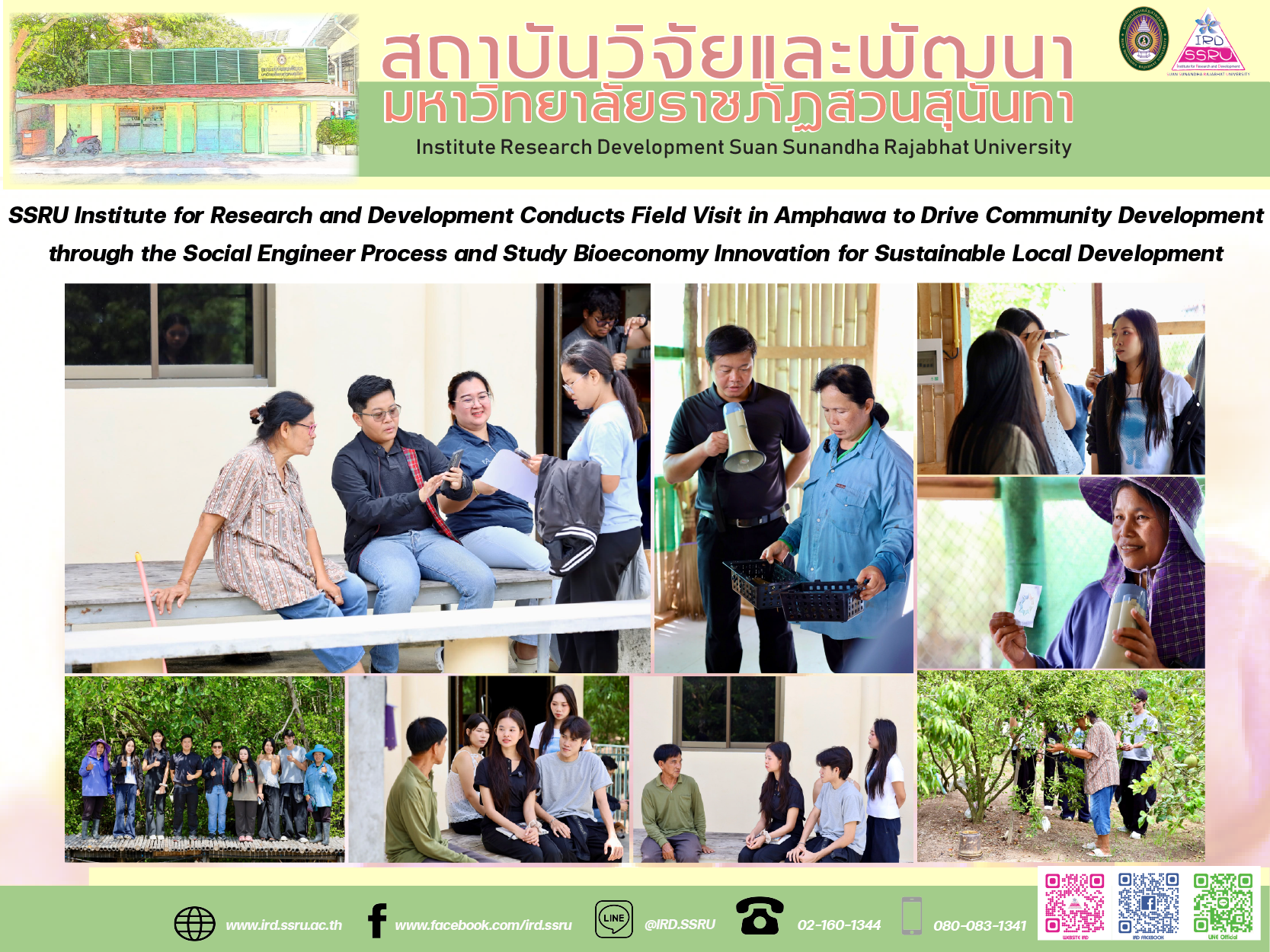
SSRU Institute for Research and Development Conducts Field Visit in Amphawa to Drive Community Development through the Social Engineer Process and Study Bioeconomy Innovation for Sustainable Local Development
On June 29, 2026, the Institute for Research and Development, Suan Sunandha Rajabhat University, under the supervision of Asst. Prof. Dr. Morakot Worachairungreung, Director of the Institute for Research and Development, assigned Lecturer Atidtaya Buasri, Vice-Director for Intellectual Property Management and Business Incubation, together with students from the Social Engineer Project, to conduct a field visit at Ban Kwae Om Sufficiency Agriculture Community Enterprise, Amphawa District, Samut Songkhram Province. The visit aimed to expand and further develop the project on enhancing entrepreneurial competencies for local development through the Soft Skills development process, known as the “Social Engineer” approach.During the field visit, Social Engineer students from the Architecture Program and the Faculty of Fine and Applied Arts participated in discussions with the community, surveyed the area, and studied local needs related to the development of product distribution spaces and community shops. The students aimed to design spaces that reflect local identity, enhance product display efficiency, and upgrade the area into a central hub for distributing community products and agricultural produce. This initiative is expected to add value, increase marketing opportunities, and generate sustainable income for the community.In addition, the executives and students visited and studied at the Learning Center for Mangrove Medicinal Plants under the project “Enhancing the Competitiveness of the Mud Crab Business throughout the Supply Chain through Innovation Based on the Bioeconomy Concept.” The center serves as a learning site for the conservation and sustainable utilization of mangrove resources, as well as a platform for exchanging knowledge in research, development, and the extension of local wisdom toward applications in medicine and health.On this occasion, Mr. Ekachon Noi-ngern, Director of the General Affairs Division, Samut Songkhram Campus Office, together with personnel from the Building and Facilities Section of the General Affairs Division, Samut Songkhram Campus Office, served as resource persons. They shared knowledge on learning center management, natural resource conservation, and the application of bioeconomy innovation. The session enabled students to apply the knowledge gained to develop, extend, and address community issues in a practical and tangible manner.This activity reflects the university’s role in integrating knowledge, research, and innovation with real-world area-based learning. It supports student potential development, strengthens local communities, and promotes sustainable local development in accordance with Suan Sunandha Rajabhat University’s mission to serve as a driving force for community and social development.The activity aligns with the Sustainable Development Goals (SDGs), particularly SDG 4: Quality Education, through the promotion of experiential learning; SDG 8: Decent Work and Economic Growth, through the enhancement of entrepreneurial potential and income generation for communities; SDG 9: Industry, Innovation and Infrastructure, through the application of innovation and the bioeconomy concept; SDG 11: Sustainable Cities and Communities, through the development of community economic spaces based on local identity; SDG 15: Life on Land, through the conservation and sustainable use of mangrove resources; and SDG 17: Partnerships for the Goals, through integrated collaboration among the university, government agencies, and local communities to create concrete and sustainable development outcomes.