
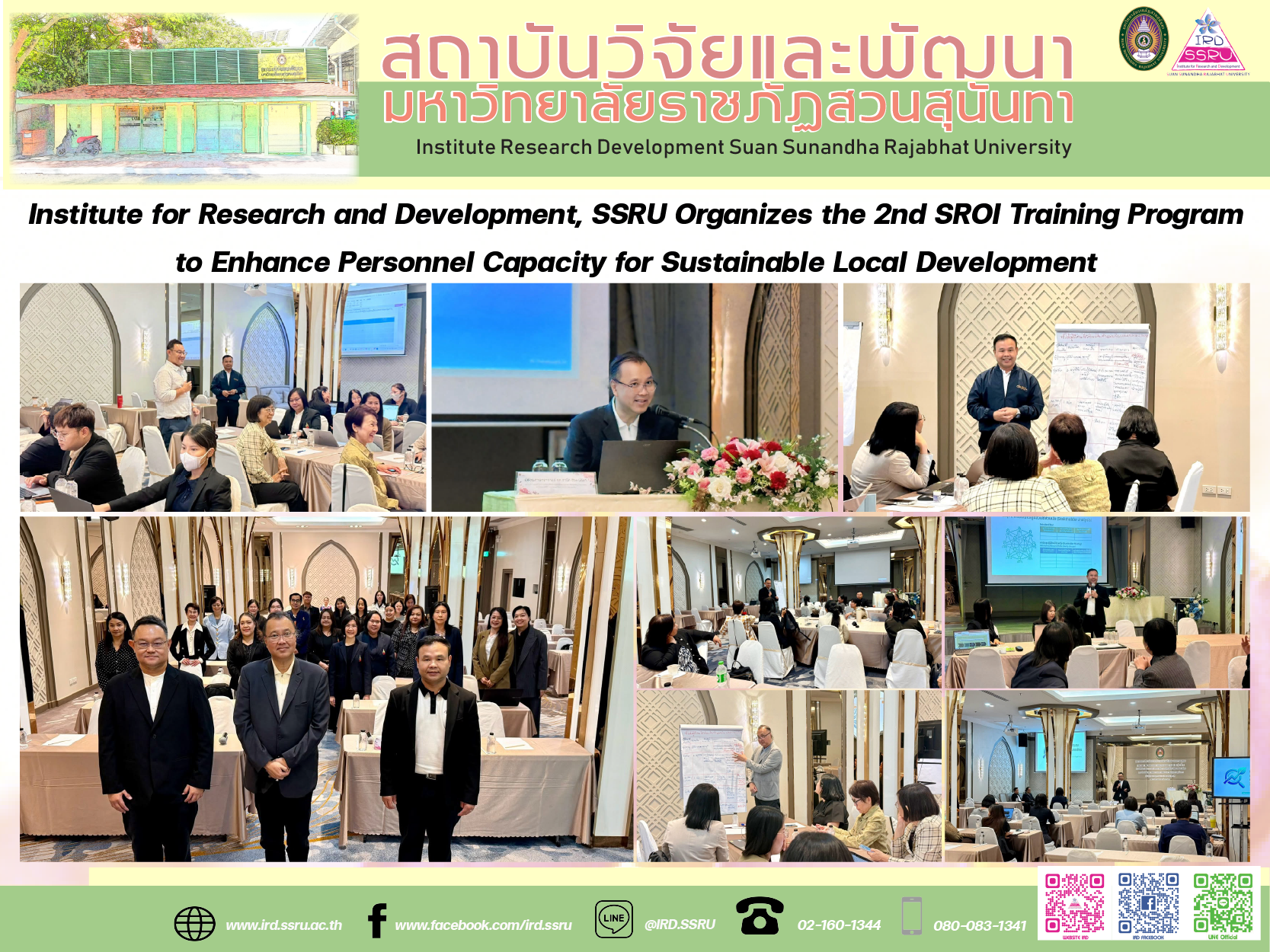
Institute for Research and Development, SSRU Organizes the 2nd SROI Training Program to Enhance Personnel Capacity for Sustainable Local Development
The Institute for Research and Development, Suan Sunandha Rajabhat University, organized a hands-on training workshop titled “Social Return on Investment (SROI) Assessment, Batch 2” from July 31 to August 1 and from August 6 to 7, 2026, at S.D. Avenue Hotel, Bangkok. The training was conducted under the Rajabhat University Strategy for Local Development Project and aimed to enhance the capacity of project personnel and relevant stakeholders by equipping them with knowledge, understanding, and practical skills in applying SROI tools to systematically assess the social outcomes and impacts of projects.
The training reflects the university’s commitment to continuously developing personnel capacity. It focused on strengthening essential skills, including stakeholder analysis, linking project resources with outputs and outcomes, identifying changes experienced by target groups, and assessing the social value generated from investment. These skills will enable personnel to apply assessment results to project planning, improvement, and enhancement in order to better respond to the needs of local communities.
On this occasion, Asst. Prof. Dr. Morakot Worachairungreung, Director of the Institute for Research and Development, assigned Asst. Prof. Dr. Wat Ploysri, Vice-Director for Academic Services, to preside over the opening ceremony. He also presented the background and objectives of the training, emphasizing the importance of developing knowledge and skills in social return analysis. The training aimed to enable participants to assess the value, outcomes, and changes generated by academic service projects and university strategic projects based on clear criteria and supporting evidence.
The training was honored by the participation of distinguished speakers, including Asst. Prof. Dr. Jaruek Singprecha, Director of the Center for Feasibility Studies and Economic and Social Impact Assessment of Research Projects, Faculty of Economics, Chiang Mai University, and Asst. Prof. Dr. Somboon Niyom, Lecturer in the Mathematics and Statistics Program, Faculty of Science and Technology, Nakhon Sawan Rajabhat University. They shared knowledge, concepts, and professional experience in social impact analysis, as well as step-by-step processes for assessing Social Return on Investment.
In addition to theoretical learning, participants engaged in practical exercises through case analysis and presentations, as well as group discussions and knowledge exchange. These activities helped strengthen participants’ understanding of how to connect resources, outputs, outcomes, and changes experienced by target groups. They also enabled participants to more clearly identify the data and evidence required for assessing social value in a concrete and practical manner.
Learning through case studies also prepared participants to apply SROI concepts and assessment processes to academic service activities under the Rajabhat University Strategy for Local Development Project. The knowledge gained can also be extended to the evaluation of research projects and other academic service projects in the future, allowing monitoring and evaluation processes to more clearly reflect changes and value created for beneficiaries and local communities.
This initiative was not limited to knowledge transfer; it also laid an important foundation for personnel to use data and empirical evidence in project assessment and development. The activity aligns with Sustainable Development Goal 4: Quality Education, particularly in promoting knowledge and skills necessary for professional practice. It also supports SDG 16: Peace, Justice and Strong Institutions by enhancing organizational systems to be more effective, accountable, and capable of measuring outcomes.
The training therefore reflects the role of Suan Sunandha Rajabhat University as a university for local development. It demonstrates the university’s emphasis on enhancing personnel capacity alongside the development of systematic monitoring and evaluation mechanisms. These efforts support research projects, academic service projects, and local development initiatives in creating appropriate and sustainable economic, social, and quality-of-life value for people and communities.