
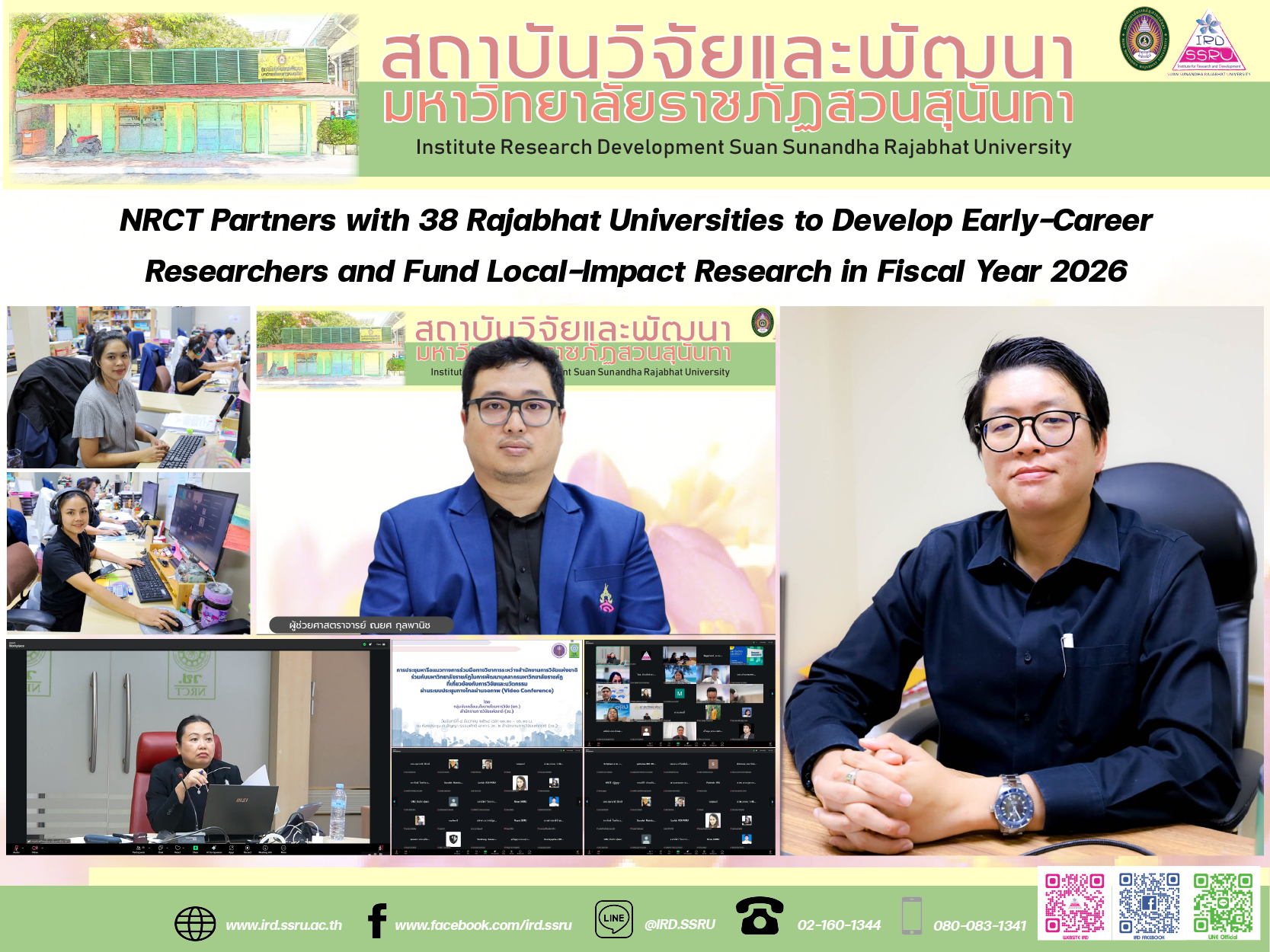
NRCT Partners with 38 Rajabhat Universities to Develop Early-Career Researchers and Fund Local-Impact Research in Fiscal Year 2026
On 8 December 2025, the National Research Council of Thailand (NRCT) convened a coordination meeting with all 38 Rajabhat Universities nationwide to define pathways for strengthening early-career researcher capacity and enhancing the quality of area-based research that directly addresses local development needs. The meeting was marked by strong multi-stakeholder collaboration aimed at building a resilient, sustainable researcher network.
Representing Suan Sunandha Rajabhat University were AsstProf Dr.Morakot Worachairungreung, Director of the Institute for Research and Development; Asst.Prof.Nayot Kulpanich, Vice-Director for Research and Publication; Miss Suangsuda Subjaroen, Head of Research and Publication; and Miss Chutima Teerasuwan, Research Officer.
The meeting reported progress under the “Early-Career Researcher Development” initiative—through grant-writing trainings (Cohorts 1–6) and a mentoring program that has expanded research skills across regions—and launched the Early-Career Researcher Course, Cohort 7 (FY2026) to meet the growing demand for high-quality research. NRCT also outlined the FY2026 research and innovation funding framework, including:
Researcher development grants under the national STI (Wiwan.) research-network collaboration framework (Rajabhat Universities);
Capacity-building grants to advance research and innovation for local development (Rajabhat Universities).
Both schemes emphasize upgrading research to solve area-based problems and translating results into tangible use. Ms. Sukanya Ameen, Director of the Research-to-Policy Driving Group at NRCT, provided detailed operational guidance to the Rajabhat University network.
This collaboration underscores the pivotal role of Rajabhat Universities in advancing local development through research, while nurturing a robust pipeline of early-career researchers to drive Thailand’s sustainable future.
Aligned Sustainable Development Goals (SDGs): SDG 4 (Quality Education) by elevating early-career researcher competencies and research-learning ecosystems; SDG 8 (Decent Work and Economic Growth) by creating research-driven career pathways and local socio-economic value; SDG 9 (Industry, Innovation and Infrastructure) by reinforcing the research-innovation ecosystem and knowledge infrastructure via funding and mentoring; SDG 11 (Sustainable Cities and Communities) by applying evidence to local challenges that improve quality of life in urban and rural areas; and SDG 17 (Partnerships for the Goals) through measurable nationwide collaboration between NRCT and the 38 Rajabhat Universities.