
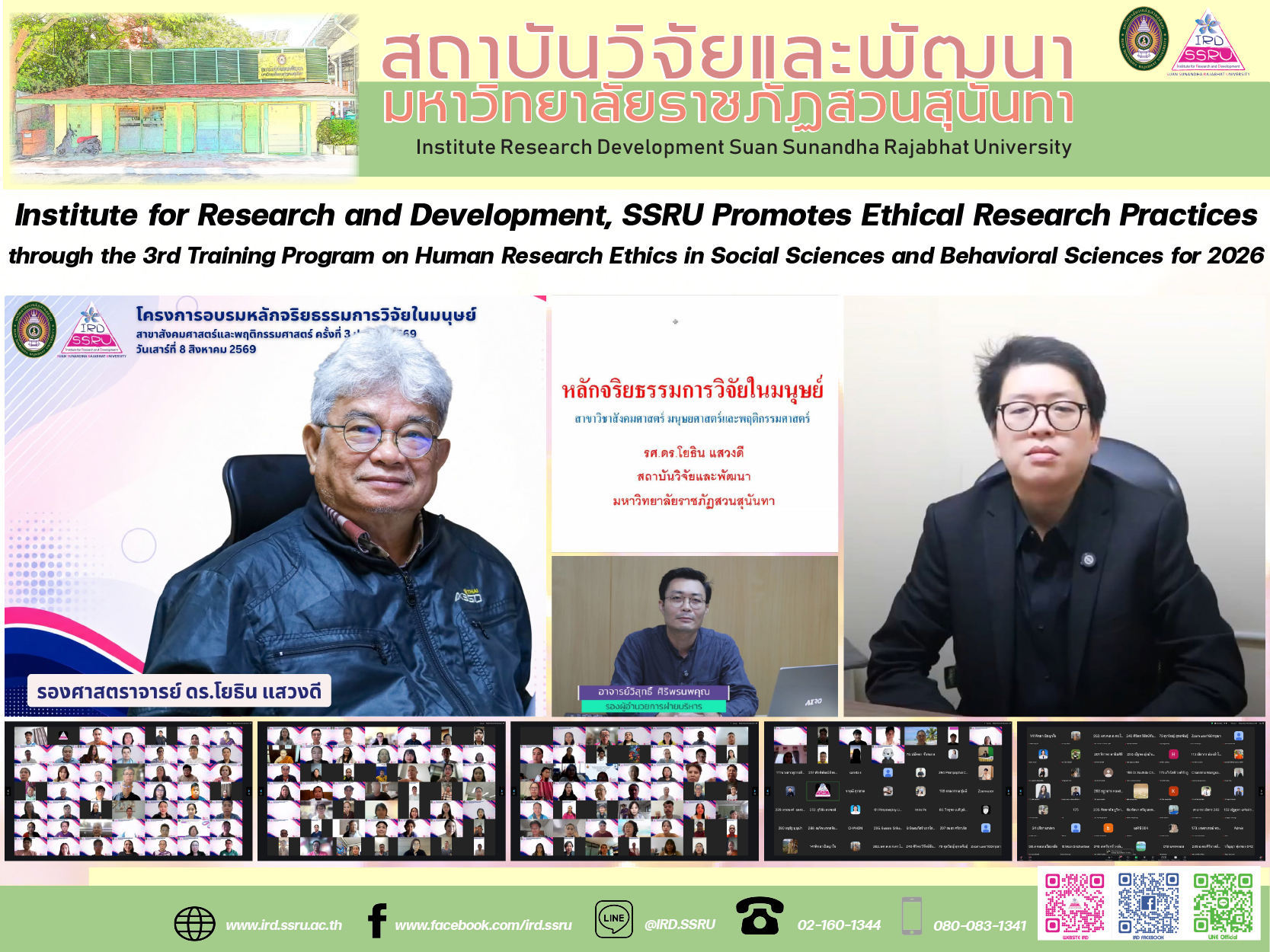
Institute for Research and Development, SSRU Promotes Ethical Research Practices through the 3rd Training Program on Human Research Ethics in Social Sciences and Behavioral Sciences for 2026
On August 8, 2026, the Institute for Research and Development, Suan Sunandha Rajabhat University, organized a training program titled “Human Research Ethics in Social Sciences and Behavioral Sciences, No. 3/2026” via Zoom Meeting. The program aimed to enhance knowledge and understanding of research ethics among lecturers, researchers, and relevant personnel, serving as an important approach to improving research quality in accordance with international standards.
The program was honored by Asst. Prof. Dr. Morakot Worachairungreung, Director of the Institute for Research and Development, who presided over the opening ceremony. Lecturer Wisut Siripornnopakhun, Vice-Director for Administration, delivered the report. The lecture on “Human Research Ethics” was delivered by Assoc. Prof. Dr. Yothin Sawaengdee, Chairperson of the Human Research Ethics Committee in Social Sciences and Behavioral Sciences, Suan Sunandha Rajabhat University.
The lecture focused on providing participants with a systematic understanding of key principles of human research ethics. The content covered research project design and development, appropriate participant recruitment, risk-benefit assessment, confidentiality, and personal data protection. These principles are essential to ensuring that every stage of the research process prioritizes the rights and dignity of human participants.
A total of 297 participants attended the training, comprising 221 internal university personnel and 76 external participants. Participants joined the lecture, exchanged views, and discussed issues related to human research through the online Zoom Meeting platform.
The knowledge assessment results clearly reflected participants’ learning development. The average pre-training score was 65.56 percent, which increased to 88.00 percent after the training. This indicates that the activity significantly contributed to enhancing participants’ knowledge and understanding of human research ethics, while preparing them to apply ethical principles more effectively in designing, planning, and conducting research projects.
The training aligns with the Sustainable Development Goals (SDGs), particularly SDG 4: Quality Education, through the development of knowledge, skills, and competencies among research personnel. It promotes learning that can be applied in real work settings and supports the development of personnel who are prepared to conduct research in accordance with professional standards and ethical principles.
At the same time, the activity is linked to SDG 16: Peace, Justice and Strong Institutions by promoting a research culture based on good governance, transparency, accountability, and verifiability. It helps personnel understand the role of the research ethics review process and recognize that ethical oversight is not merely a documentary procedure, but an essential mechanism for protecting research participants and strengthening confidence in the organization’s research system.
The activity also supports SDG 3: Good Health and Well-being, as human research ethics places importance on assessing and minimizing potential risks to participants, including physical, psychological, social, and privacy-related risks. It also emphasizes appropriate information provision and informed consent processes to ensure that participants’ rights, safety, and welfare are protected throughout the research process.
In addition, the emphasis on fairness and non-discrimination is connected to SDG 10: Reduced Inequalities, particularly in protecting vulnerable individuals or groups, ensuring appropriate participant selection, and fairly considering the distribution of research risks and benefits. This helps ensure that research practices respect the rights and dignity of all individuals equally.
In terms of research system development, the activity is also related to SDG 9: Industry, Innovation and Infrastructure, as it lays a foundation for quality and standards among research personnel. This is a key component in strengthening a robust research and innovation system. Developing researchers who conduct their work based on academic principles, ethics, and social responsibility will help ensure that future research and innovation outputs are credible and can be appropriately utilized.
The Institute for Research and Development, Suan Sunandha Rajabhat University, remains committed to continuously promoting knowledge development in research ethics. This effort not only enhances researchers’ skills, but also supports the university’s research system in emphasizing quality, responsibility, and operational standards—an essential foundation for creating reliable knowledge and advancing sustainable development in the future.