
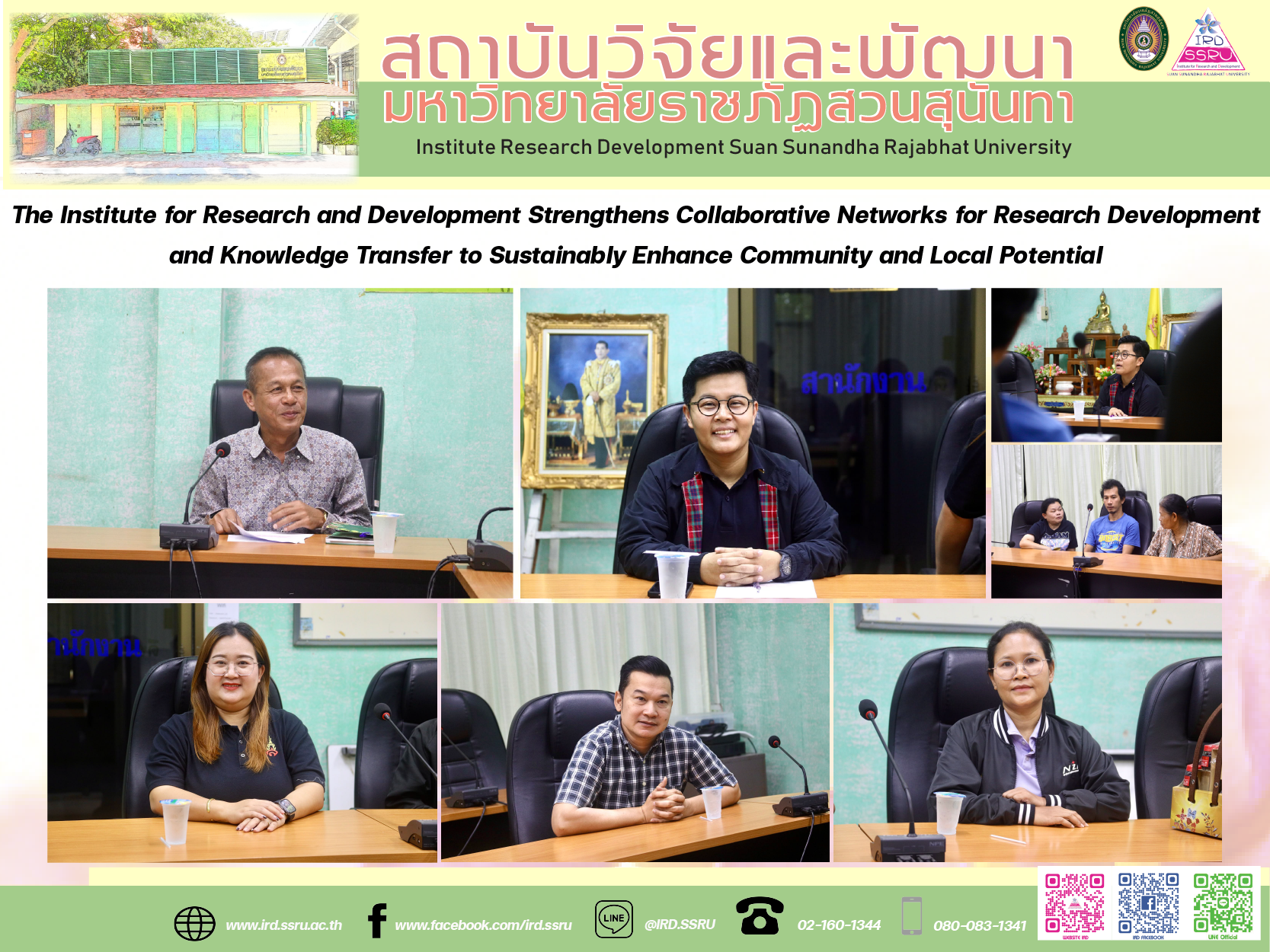
The Institute for Research and Development Strengthens Collaborative Networks for Research Development and Knowledge Transfer to Sustainably Enhance Community and Local Potential
On June 11, 2026, the Institute for Research and Development, Suan Sunandha Rajabhat University, through its Intellectual Property Management and Business Incubation Division, led by Lecturer Atidtaya Buasri, Vice-Director of Intellectual Property Management and Business Incubation, under the supervision of AsstProf Dr. Morakot Worachairungreung, Director of the Institute for Research and Development, attended a meeting to discuss cooperation in research and academic services with Kwae Om Subdistrict Administrative Organization.
The meeting was led by Mr. Danai Khajonphon, Chief Executive of Kwae Om Subdistrict Administrative Organization, together with Mr. Thanasak Bussabok, Deputy Chief Executive of Kwae Om Subdistrict Administrative Organization, and representatives from community network partners, including Mr. Prasert Hengprasert, Chairperson of Ban Kwae Om Sufficiency Agriculture Enterprise, and Ms. Wilailak Chaemklam, a member of Ban Kwae Om Sufficiency Agriculture Enterprise. The meeting was held at the meeting room of Kwae Om Subdistrict Administrative Organization, Amphawa District, Samut Songkhram Province.
The meeting was organized under the project to upgrade research-based prototype products toward commercialization under the concept of the creative economy, as well as the project to develop entrepreneurial competencies for local development through soft skills processes, also known as the Social Engineer approach. The objective was to foster collaboration among the university, government agencies, and community sectors by integrating knowledge, research, innovation, and academic services to jointly enhance community potential, enabling communities to become stronger, more self-reliant, and sustainable.
During the meeting, participants jointly discussed operational guidelines for research, academic services, and the transfer of technology and innovation to local communities. The discussion focused on upgrading community products to meet quality standards, increasing their value, strengthening local identity, and creating concrete opportunities for commercialization. These efforts are expected to generate income, enhance competitiveness, and improve the quality of life of people in the local area.
In addition, the initiative promotes the university’s role in local development by providing students with opportunities to apply knowledge gained from classroom learning to address real community issues and support community development through the Social Engineer process. This approach serves as an important mechanism for producing practical graduates who possess public-mindedness, social responsibility, and the ability to create positive and sustainable change within communities.
This initiative aligns with the Sustainable Development Goals (SDGs), particularly SDG 1: No Poverty, through the creation of income-generating opportunities for communities; SDG 8: Decent Work and Economic Growth, through the development of entrepreneurial potential and community products; SDG 9: Industry, Innovation and Infrastructure, through the application of knowledge, research, and innovation for area-based development; and SDG 17: Partnerships for the Goals, through the establishment of collaborative networks among the university, government agencies, and the public sector to jointly drive concrete and sustainable community and local development.